
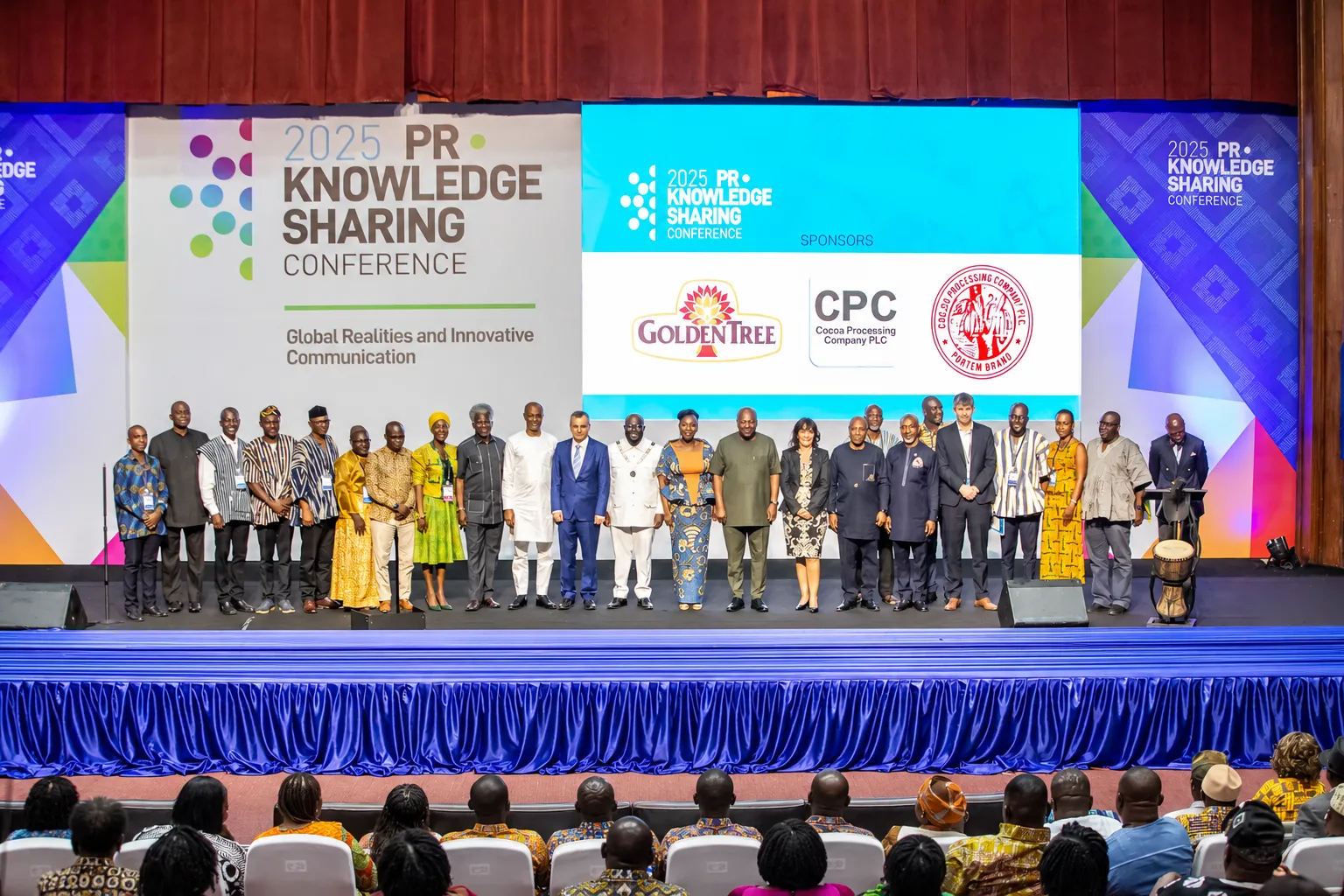
Accra, Ghana – 3rd October 2025
2025 PR Knowledge Sharing Conference Calls for Strategic Communication to Drive Africa’s AI and Development Agenda
The 2025 Public Relations Knowledge Sharing Conference has called for stronger strategic communication, public trust, ethical use of Artificial Intelligence (AI) and greater African participation in shaping the continent’s digital and development future.
Held from 1st to 3rd October 2025 at the Accra International Conference Centre (AICC), the three-day conference brought about 600 participants, including Public Relations and communication professionals, policymakers, academics, development practitioners, private-sector leaders and students from Ghana and other parts of Africa, as well as the international community.
The conference, themed “Global Realities and Innovative Communication,” was organised by the Institute of Public Relations (IPR), Ghana in collaboration with the African Public Relations Association (APRA), the International Public Relations Association (IPRA) and the Public Relations Society of Kenya (PRSK).
Discussions focused on Artificial Intelligence and Africa’s development, digital policy, socio-economic transformation, data and communication, public trust, organisational preparedness and the role of Public Relations in influencing behaviour and addressing national challenges such as illegal mining.
In her opening remarks, Esther A. N. Cobbah, FIPR, President of IPR Ghana, emphasised the responsibility of communication professionals to understand the rapidly changing digital environment and acquire the competencies needed to contribute meaningfully to development.She noted the importance of communication practitioners being equipped to understand emerging technologies, interpret their implications, build trust and help institutions and citizens navigate change.
Hon. Felix Kwakye-Ofosu, Minister for Government Communications, speaking on “Mobilising the Citizenry for Development: The Central Role of Communication,” highlighted communication as essential to building public trust, strengthening civic participation and bringing citizens on board national development initiatives.
The conference also featured a keynote address by Jan Eissfeldt, Director and Global Head of Trust and Safety at the Wikimedia Foundation, on “Africa and AI – Now and the Future.”He highlighted the importance of ethical frameworks, digital literacy, culturally grounded communication, trust and inclusion, as well as the need for African languages, experiences, cultures and perspectives to be represented in the data and systems shaping the future of AI.
Other discussions on the first day examined the cultural implications of AI, organisational preparedness, internal communication and the need for communication professionals to work more closely with technology experts. A students’ session also explored the opportunities AI presents for learning and the risks associated with unequal access.
The second day focused on the sub-theme, “AI and Socio-Economic Development,” examining how Artificial Intelligence could contribute to Africa’s development and the relationship between technology, policy, human development and strategic communication.
Hon. Sam Nartey George, Minister for Communication, Digital Technology and Innovations, speaking on “Our Development Agenda in the Era of AI,” highlighted Ghana’s efforts to develop AI systems that respond to local realities, including partnerships between government and academia to develop large language models in Ghanaian languages.Work had been completed in Twi, Ga and Ewe, with development continuing in Dagbani, Zima and Kusasi, while regional initiatives were also advancing work in Yoruba, Hausa, Creole and Swahili.Emphasising the importance of African ownership in the development of emerging technologies, he stated, “AI must be built for the continent, by the continent.”
A ministerial roundtable featuring Hon. Felix Kwakye-Ofosu, Minister for Government Communications, Ghana; Hon. Sam Nartey George, Minister for Communication, Digital Technology and Innovations, Ghana; and Hon. Godfrey BalukuKabbyanga, Minister of State for ICT and National Guidance, Uganda, further explored Africa’s growing potential in AI and the importance of transparency, ethics, inclusion and effective storytelling in building public trust.
Other sessions examined digital policy for Africa, AI for Ghana and the IPRA AI Guidelines, including the need for regulatory systems that protect the public while allowing innovation to flourish. Discussions also highlighted the role of communication professionals in helping citizens understand and engage with emerging policies.
The conference further explored the potential of AI to help address inequalities in health, education and income, provided it is deployed with inclusion and human dignity at its centre.
Practical case studies demonstrated how AI is already being applied to development challenges in areas including informal finance and education. Discussions on data also highlighted the growing relevance of social listening, sentiment analysis and predictive modelling in helping communication professionals better understand audiences and anticipate changes in public perception.
The third day of the conference focused on “Public Relations and Behaviour Change: Addressing Illegal Mining (Galamsey),” examining why communication must form part of the response to one of Ghana’s persistent environmental and socio-economic challenges.
Hon. Alhaji Yussif Sulemana, Deputy Minister for Lands and Natural Resources, speaking on “The Fight Against Galamsey: All hands ondeck,” highlighted the role of communication in shaping behaviour, building trust and encouraging responsible environmental stewardship.
Discussions stressed that addressing illegal mining requires more than enforcement and must also be understood as a behavioural and communication challenge. Participants highlighted the need to engage communities, trusted local voices, religious leaders and other influencers through culturally relevant behaviour-change communication, transparent communication systems, rapid responses and storytelling capable of moving people from awareness to action.
A major highlight of the conference was the keynote address by H.E. John Dramani Mahama, President of the Republic of Ghana, who attended the conference in person and personally delivered his address.
President Mahama underscored the strategic importance of communication in Ghana’s development and in harnessing emerging technologies for national progress.His address connected the potential of AI with governance, climate action and socio-economic transformation, while emphasising the need for communication that is ethical, inclusive and forward-looking.The President’s address reinforced one of the central messages of the conference: national development depends not only on the policies governments pursue or the technologies institutions adopt, but also on how effectively these are communicated, understood and embraced by citizens.
The conference concluded its substantive programme with a Continental Solidarity Session involving the leadership of IPR Ghana, APRA, PRSK and IPRA, symbolising a shared commitment to strengthening the Public Relations profession and deepening collaboration across Africa.
Across the three days, the conference reinforced the changing role of the communication professional. Beyond explaining what organisations are doing, practitioners are increasingly required to understand technology, interpret data, engage communities, anticipate public concerns, build trust, influence behaviour and help organisations respond strategically to a rapidly changing world.Participants identified Artificial Intelligence, data analytics, behaviour-change communication and the stronger positioning of communication as a strategic function as important priorities for the profession.The conference also reinforced the value of practical learning, collaboration and cross-country knowledge exchange, and demonstrated the important place of communication at the intersection of technology, people and development.
The conference was held in partnership with the International Public Relations Association (IPRA), the Public Relations Society of Kenya (PRSK) and the African Public Relations Association (APRA), with support from Ghana Television (GTV), Kenya Airways, the Ministry of Foreign Affairs, Global Media Alliance, Bui Power Authority, Stratcomm Africa, Comms of Africa, the Volta River Authority (VRA), Ghana Cocoa Board, the Ghana National Petroleum Corporation (GNPC), Ghana Water Company Limited, Stanbic Bank, the Ghana Revenue Authority (GRA) and the Ghana Ports and Harbours Authority (GPHA).
ABOUT INSTITUTE OF PUBLIC RELATIONS (IPR), GHANA
The Institute of Public Relations (IPR), Ghana is the professional body for Public Relations practitioners in Ghana. It was founded in 1972 and registered as a professional body under the Professional Bodies Registration Decree, 1973 (NRCD 143). Among its roles, IPR Ghana exists to provide a professional structure for the practice of Public Relations and enhance the ability and status of its members as professional practitioners.
For more information, visit www.iprghana.org
MEDIA CONTACT
Esenam Agyekumhene
IPR Ghana Secretariat
+233 500 481 062
info@iprghana.org
END